Thursday, June 28, 2012

End of the Year

I am home for the summer, and back to the blog after a busy last couple of weeks.

School is out and my first year of teaching finished. My students and I say thank you to all my supporters who have made it possible for me to be in Nicaragua, teaching and sharing God's love with my 4th graders.


To celebrate the end of the year and the fact that, as a class, we read over 1,000 books, we had a monster book party!


Students who completed their individual book goals each received some "Book Worms". 


....

During my last couple of days in Nicaragua I was able to connect with some of my Nicaraguan host families that have hosted me during my short term trips to Nicaragua years ago. These are people that impacted me greatly and helped shape my love for this country.


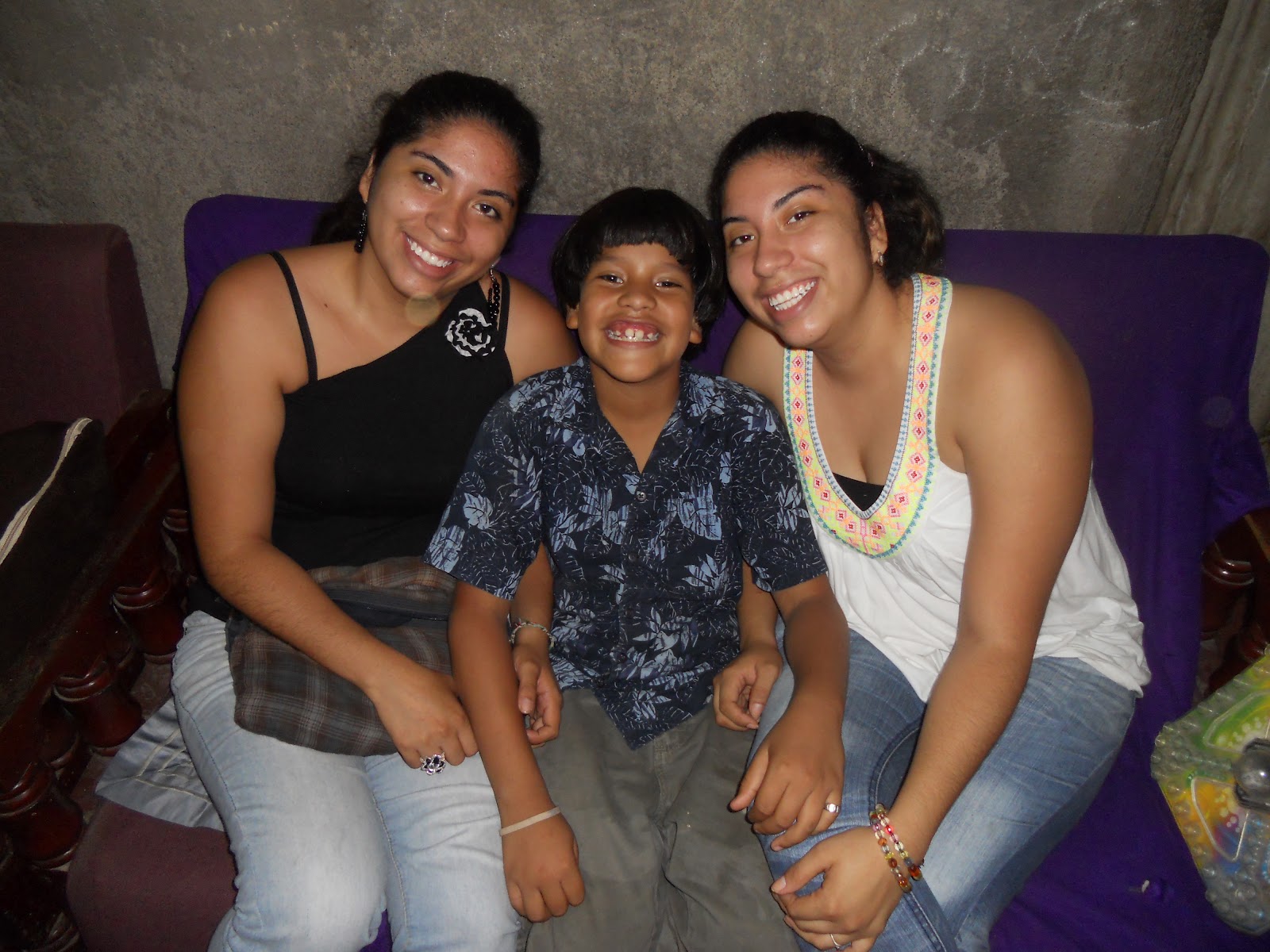
I stayed with this family in Diriamba four years ago. The two oldest girls are twins and share my birthday. When I visited them, the younger boys were playing a game I had given them four years ago. When language is an issue, games and laughter always bridge the gap. I am going to bring them some new board games in the fall.


This was my first host family. When I stayed with them back in 2006, I was able to really put my Spanish to use, I learned how to hand wash my clothes, and I discovered the joys of small amounts of electricity. At that time I already knew I wanted to live in Nicaragua, but the trip continued to confirm it.
...
I am currently in Omaha, enjoying time with my family and preparing for next school year. Thanks for following me throughout my first year in Nicaragua!

Thursday, May 31, 2012

Field Trip

Today was a field trip day, every student's dream come true. We journeyed over to La Prensa, the main newspaper agency in Nicaragua.


We have been studying the printing press, the pony express, newspapers, and the spread of ideas in Social Studies class. A couple of weeks ago we went out to the soccer field and raced messages across the field in a mock pony express (minus the ponies). We decided current modes of transporting and communicating news is a lot more efficient.


Next we wreaked havoc at McDonald's, where we stopped for lunch.


Tomorrow is our last full day of school.
Monday we have a half day where my class will celebrate our accomplishment of reading over 1,000 books as a class. There will pizza, a movie, and of course, books!
Tuesday and Wednesday are also half days... and then we are done!

I am slightly overwhelmed with thoughts this week. My first year in Nicaragua is almost complete and God has done so much. I survived my first year as a teacher. The hardest year is behind me! I am excited for my two friends to come visit me in a week and a half... and then I'll be flying home for a summer visit! Thankful, blessed, excited, a little tired... I see God's goodness all around me.


xooxoxo
Laura


Sunday, May 20, 2012

Daniel and Esther

In 4th grade Bible class we spend the year digging deeper into the Old Testament. We review a lot of the stories that children grow up learning, but we go deeper into them and examine the time in history that they take place, the location, and how the stories and characters affect everyone around them. We spent a long time looking at the kings of Israel and Judah and just finished learning about the exile. Last week we learned about Daniel, a young man affected by the exile. My students spent three days in groups reading different stories from Daniel, researching about Babylon, and drawing pictures of the key items in the stories. One group had the story from Daniel 5 where King Belshazzar gives a banquet for a thousand of his nobles. During the meal a human hand appears and writes on the wall. Daniel is the only one that can interpret what it means. My students had never heard this particular story and were amazed that it was in the Bible. "Did that really happen? It sounds like a ghost story. How can a hand just appear out of nowhere?"

On Friday we started talking about Esther. My students had all heard this story as well, but they didn't know much of the background on it. They learned about the size of King Xerxes kingdom and the hatred that Haman had for Mordecai and the Jews. We learned about signet rings and scepters and the different roles people had in the palace. I read them the first part of the story from a Bible story book, and for the first time that day, they all sat perfectly quiet. They groaned when I put the book down to start math. I love that God's stories can captivate us, just like any good book can.

We are now down to two and a half weeks of school. Most schools in the States are out or are getting out this week. My students are ready to be done - but the fun isn't over yet!


Sunday, May 13, 2012

Mother's Day


I love Nicaragua, but at times it is a little rough being away from my mom. Who else makes the world's best tuna fish sandwiches on a Sunday afternoon? That's right, no one.

Happy Mother's Day, Mom! Sending love your way. xoxoxooo


Thursday, May 3, 2012

Book Day

In case you missed the news, last Friday was Book Day!


I have a not so secret passion for reading and books in general, so I freaked out a little when my principal told me the news. I passed on the excitement to my students, but I think my excitement might have surpassed theirs. A whole day devoted to books! You know I love seeing what my students are reading and celebrating with them when they finish a book. They love to check up on my reading progress and try to guess how many pages I read the night before. Book Day had an extra portion of celebrating books including:
Book show and tell
Dress like your favorite book character
Reading buddies with the younger graders
All of elementary having D.E.A.R. (drop everything and read) time together

Our favorite books and character costumes (that's my Jane Austen bonnet)!
Normal classroom chaos
Percy Jackson and the Olympians Series is big in my class this year. These students are rocking their "Camp Half-Blood" t-shirts.


I love when they are reading!


Sunday, April 15, 2012

Testing and Teachers


This week is testing week! At NCA, we only do standardized tests every other year. They aren't a big deal like they are in the United States. My job or the school does not depend on it in any way. They are simply a way to compare our school to others in Nicaragua and in the U.S. That takes away all the stress that I know the teachers in the U.S. feel. However, testing week means a lot of sitting very still and being very quiet. In my class of extra hyper students, I am having some unpleasant thoughts of what this week might looks like for me! Thankfully, God knows and will be my strength this week. 

Below is an article I ran across on teachers in Nicaragua.


In Nicaragua, teachers make only half as much as market vendors


Nicaragua's Sandinista government vowed a 'battle for sixth grade' to combat one of the world's highest dropout rates. But their goals are not reflected in the budget.
By Tim Rogers, Correspondent / March 26, 2012

MANAGUA, NICARAGUA
Since returning to power in 2007, Nicaragua's President Daniel Ortega has championed education as a priority for his administration, and a hallmark of his government’s socialist work.

Mr. Ortega decreed education free for all, deployed a nationwide literacy campaign, and valiantly declared a “battle for sixth grade” – an important goal in a country that has one of the highest dropout rates and lowest high-school enrollments in the world.
But when it comes to paying the bill for education, the government hasn’t followed through, analysts say, and as a result education is not improving. Not only are textbooks and classrooms outdated, but standards for college admissions are falling and educators are amongst the most underpaid professionals in the country. And the low wages promised to teachers, some say, is telling of the government's true commitment to improving education.
“The glass ceiling for the quality of education is the quality of teachers. And there is no way to attract better and more qualified teachers to the profession if people can earn twice as much doing just about any other job,” says Adolfo Acevedo, an economist with the Civil Coordinator public policy and activist group.

National salaries 'biased against teachers'

“The national salary structure’s bias against teachers is overwhelming,” Mr. Acevedo says.
Not only are Nicaraguan teachers the worst paid in Central America, but they’re also among the worst paid professionals in Nicaragua. In real wage terms, an average public school teacher in Nicaragua earns less than 60 percent of the average wages for other jobs, and only half of what it costs to provide the canasta basica, a list of 56 basic food and household items needed to support an average family.
Teachers in Nicaragua earn less than miners, factory workers, construction workers, and government functionaries who stand in traffic rotundas waving Sandinista flags at passing cars, according to a comparative study on real purchasing power, Acevedo says. Most teachers earn only half as much as a market vendor.
“The average teacher is either living in poverty or right on the verge,” Sandinista analyst Oscar Rene Vargas says.
Teachers in Nicaragua earn around $185 to $226 a month, according to estimates by Acevedo and José Antonio Zepeda, president of the National Confederation of Nicaraguan Education Workers (ANDEN).
“Despite the continuous salary increases over the past six years – representing a total of 140 percent in wage increases – teachers still don’t earn enough to meet the costs of the canasta basica,” Zepeda said.
This is because any salary increase on paper has been virtually cancelled out by inflation and the increases to costs of living, says Acevedo.
“The salary increase projected for teachers in 2012 is 9 percent, but inflation is projected to be 7.95 percent,” he says. If projections are correct, the real increase in teacher salaries will be 1.05 percent. “At that rate of growth, teachers will need to wait 65 years for their salaries to catch up with the average national salary,” Acevedo says.

Actions speaking louder than words

“The deficit in education spending is not a problem that started with this government, but this government has not changed the tendency of underfunding,” says Mr. Vargas. “The situation is stagnant.”
Though the Ortega administration has lobbied the World Bank and EU for outside financing to support its education strategy – a plan Sandinista officials have quietly presented to international donors but kept guarded from any public scrutiny – the government is hesitant when it comes to opening its own purse strings to pay teachers’ salaries, says Mr. Acevedo.
Ortega, who receives nearly $500 million a year in Venezuelan aid, recently thanked teachers for their “vocation for service.” But despite his thanks, critics say the Ortega government once again did not do enough to address low salaries for educators in the 2012 budget, which was hurried through National Assembly earlier this month by the Sandinista supermajority.
The Ministry of Education’s (MINED) department of public relations said they weren’t authorized to give out information about teachers’ salaries, and also ignored written requests for information.
But some say the problem isn’t lack of funding, but how government money is spent.
For example, in the 2012 budget the government earmarked $111 million – double what it spent last year – on paying down the internal debt. At the same time, this year’s budget will increase education spending by $20 million, which means in terms of gross domestic product (GDP), education spending will be the same as it was last year: 3.7 percent.
That’s only half of what the country should be spending on education, Acevedo says. “The country needs to establish its priorities.”

Poor quality of education

Nicaragua’s cash-strapped school system is amongst the world’s lowest in terms of secondary-school enrollment:  Only 45 percent of students who enter primary school go on to high school.
Many of those who do make it to high school may not be learning much more than those who drop out, though. The country’s high schools only have enough books to cover 55 percent of the students, something the Ministry of Education blames on a lack of the estimated $6 million needed to print new texts. The ministry hopes the funding will become available by the end of the year.
Those who do attend high school are not held to education standards or international benchmarks. The country performed so poorly in worldwide standardized testing that it stopped participating in global testing several years ago.
And according to recent university entrance exams, only 10 percent of students pass the basic math requirements, and 20 percent pass the Spanish-language requirement.  Scores were so low that the National Autonomous University of Nicaragua in León last year lowered the passing grade on its entrance exam to 54 out of 100. But even then, only 68 percent of the high school graduates passed.
“There is a lot of government propaganda about education, but the quality of education in Nicaragua still leaves a lot to be desired,” says Carlos Tünnermann, the first Sandinista government’s minister of education and a former member of the UNESCO Director-General’s Advisory Group for Higher Education in Latin America.
- The Christian Science Monitor 

Friday, April 6, 2012

Costa Rica

Three flat tires, suspension bridges in the rain forest canopy, out of the way trip to Taco     Bell = excellent Semana Santa (Holy Week) Vacation.

Three flat tires? Yes, three. Two happened in Nicaragua thanks to a pot hole the size of Kansas, and another happened up in the mountains. Thankfully, all three times were in more or less developed areas so we could get our tires fixed. And the best part: the total cost to get all the tires fixed was $8. Even though I didn't personally change any of the tires, I feel like I could be an expert now. Hopefully that knowledge wont have to be put to the test anytime soon.

Tire #1 & #2 and my corresponding feelings


Tire #3 and more feelings 
Flat tires behind us, we did what everyone must do in Costa Rica: visit the beach. We braved the banana boat and survived without any major injuries. The boat driver did his best to flip us at every chance.


Next we went up up up the mountain to Monte Verde.
On the way up, we hiked to some beautiful waterfalls.


At the top of the mountain is a cloud rain forest. Against my better judgement and my fears, my friends and I walked across eight suspension bridges through the rain forest canopy. In an attempt to describe the immensity and beauty of walking through the top of the rain forest, I will throw out and analogy to the Henry Doorly Zoo in Omaha. You know how when you walked through the jungle when you were little and you were hit with the smell, the thick air, and the feeling of being very small in the midst of something grand, very green, and alive with all sorts of animals and plants? (Not quite the feeling I have now, but you know how things seem so big when you are little.) Anyway, that was the feeling, with the added bonus of being frightened by the bridges and the height. It was beautiful and a credit to the Creator. How can he come up with so many beautiful things?


Next up: Arenal Volcano. Think Mount Doom from Lord of the Rings minus being followed for days by Gollum. We didn't go up the volcano, but in the towns around it, which happen to have an abundance of hot springs. We went to a place that had dozens of natural hot springs and man made pools as well. We went at night and could see the stars and moon above as we ducked under waterfalls and tried out all the different pools.


Ready for a not-so-funny funny story?
There are only a hand full of American type restaurants in Nica. We have McDonald's, BK, Subway, and one TGIFriday's. Costa Rica has a lot more, including the fabulous Taco Bell. We decided to pencil in a visit on our trip. The closest one is an hour and a half out of the way from where we were staying. We had built up a lot of hype about going to the Taco Bell. It would be like a little taste of America. We looked it up multiple times online, printed out a google map to it, the whole deal. So we drive an hour and half out of our way, find the mall, walk in and - - - the Taco Bell was closed because of Holy Day. All the other restaurants were open. Only Taco Bell decided to close. One day earlier, and it would have been opened. So we drove an hour and half back and went on our merry way.


And now for the boring story that must be told.
The border crossing from Nicaragua to Costa Rica took six hours. SIX! We were warned to prepare ourselves for three hours. In case you ever want to drive from Nica to Costa Rica, please prepare yourself mentally to be utterly confused. There were no signs with instructions, no buildings with labels, and no clear understanding of what needed to be done. Get this random paper, make a copy of this at the building in a random parking lot full of semis, find a cop to check your car, go back and get another copy...

And what's a travel story without animals?

Scorpion at the hotel
Hummingbird at the rainforest
Mr. creepy crawly in the rainforest
This was the first adventure of my new car! My mom van has proved its worth.


I am now back in Nicaragua in time to celebrate Easter. This whole week, "Holy Week", has a lot of meaning in Nicaragua. However, I have noticed that there is not such a big emphasis on Easter itself. Some of my students were unsure about why they had off school. It was a good opportunity to dig into the Easter story and discuss what the resurrection means. One of my students: "So the resurrection is what gives it all meaning? We need Christmas so Jesus can be born, and we need the cross, but the resurrection is where it all comes together."

Happy Easter,
Laura

But God demonstrates His own love toward us, in that while we were yet sinners, Christ died for us.